


In the construction industry, a project like this almost never goes wrong—it’s the briefing that does. Do you want to brief an exhibit builder in a way that gives you control rather than creating more work? Then do the opposite of what most people think: specify less and explain more.
Most briefings describe an object, not an encounter
Since 2001, we have built hundreds of booths in our own workshop for more than 200 brands, for trade shows in the Netherlands, Europe, and the United Kingdom. The briefings that preceded these projects can essentially be divided into two categories.The first type describes an object. The dimensions, materials, number of seats, banner height, and logo placement are all listed, and yet, after reading it, we still don't know why anyone would stop by that booth.
The second type describes an encounter. Who will be walking by, what does that person know about your market, what should the conversation be about, and what should that visitor take away from the event once it’s over? With that second type of briefing, you’ll already get some insightful feedback right from the first round.
That difference isn't a matter of writing talent, but of order. A specification is an answer to a design question that hasn't been asked yet.
"A booth that aligns with your brand identity isn't created by color codes, but by a clear story about who you want to reach."
Erwin Kocken
Three questions form the basis of your entire briefing
Everything a designer needs to create something that works comes down to three questions. Answer them clearly, and the rest of your briefing will largely write itself.Who do you want to talk to, and who don't you want to talk to?
"Our target audience is the industry" doesn't say much. "This year, we especially want to speak with technical buyers from medium-sized manufacturing companies, because that's where our biggest margin lies, and we don't need students or job seekers" says it all. It determines the height of the counter, the openness of the floor plan, the number of seating areas, and whether you set up a demo station or a meeting table.
Also explain how those people currently view your brand. Are you the established brand launching something new, or the challenger that still has to prove itself alongside three major competitors in the same hall? That’s not just marketing talk for the introduction—it’s a design directive.
What should a visitor feel in the first few seconds?
At a busy trade show, people decide in just a few steps whether your booth is worth their time. That decision is based on a feeling, not on information. Write down what that feeling should be: precision, warmth, boldness, reliability, innovation. One word, two at most.
Add to that the hardest part: what do you want them to think about you that they don't already think? That one little sentence changes a design more than ten pages of requirements.
What should have happened afterward?
Trade show goals are often not set until the booth is already set up, by which time it’s too late to do anything about them. Include in the briefing what success means: a certain number of high-quality conversations, a set number of demo appointments per day, visibility for the launch of a new line, or a place where existing customers bring their business contacts.
A booth designed to generate leads looks fundamentally different from one designed to deepen existing relationships. With the former, you keep the barrier to entry as low as possible and create many brief points of contact; with the latter, you build in a sense of calm and privacy.
A booth builder can design anything, but they can’t guess why you’re at the trade show. Your goal, target audience, and desired vibe belong on page 1, not in the appendix.
Erwin Kocken
Specification Briefing vs. Intent Briefing
| Specification Briefing | Intent Briefing | |
| Starting Point | Square meters and corporate identity | Target audience, objective, and desired vibe |
| Role of Exhibition Booth Builder | Bringing Your Sketch to Life | A partner in shaping your brand story |
| First round of design | Technically correct, unbranded | On point, with discussion about design accents |
| Revision Iterations | Frequent, and late in the process | Few, and early in the process |
| Budget Meeting | Making Changes to the Design After the Fact | Making Prioritization Decisions Up Front |
| Results on the floor | A booth that makes an impression | A brand experience that sparks conversations |
Both briefings take about the same amount of time to write. One results in one round of revisions, the other in four.
Limitations are the best material you can provide
There’s a persistent notion that you should give a creative team as much freedom as possible. In practice, the opposite is true: the more specific the parameters, the better the concept. Constraints give a designer something to push against.
So be specific about your budget—not because the price determines the design, but because it determines where we allocate the funds. With a clear budget in mind, we can choose between a spectacular element that draws attention from afar and a more understated rest of the booth, or a consistently high level of finish throughout the entire booth. Without a budget, we’re designing in the dark and will end up making cuts later on, which always comes at the expense of precisely the details that define the brand.
The same applies to time. Let everyone know internally what approvals are needed, who is reviewing the work, and when that person is on vacation. Setting a deadline in the briefing prevents last-minute rushes on the production day.
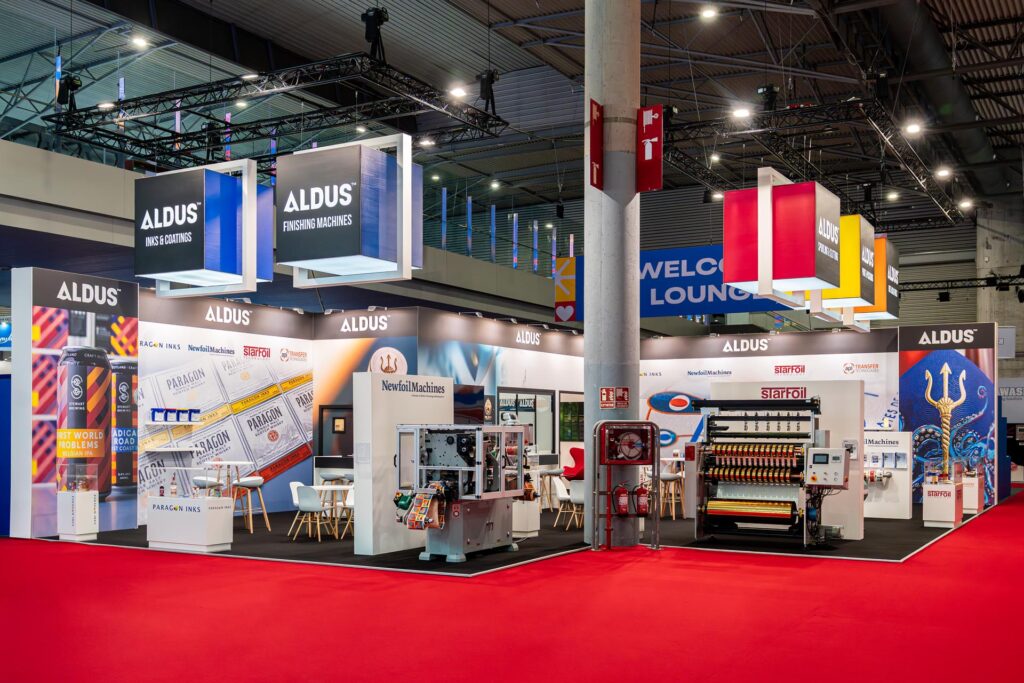
And let us know what you already have: existing elements from a previous booth, furniture in storage, a product display that worked well. We store booths for clients and rebuild them in a modified form, using sustainable materials that will last for multiple editions. We can only do this if we know in advance what’s in the warehouse.
What still needs to be put in writing
In addition to intent, every project needs a solid foundation of data. It’s best to gather all of this data at once, so you don’t end up exchanging emails back and forth for three weeks over a technical drawing:
- The organizer's booth details: booth number, dimensions, number of open sides, maximum construction height, floor load capacity, and the regulations for the relevant hall.
- The exhibition hall floor plan showing your neighbors: who is next to and across from you, and where is the main flow of visitors coming from.
- Your brand assets in a usable format: vector logos, a brand style guide, an image library, and the fonts—not a PowerPoint presentation with screenshots.
- Practical features: storage for coats and bags, a pantry, connections for electricity, water, and the internet, and whether there are any product demonstrations taking place that make noise or require ventilation.
- Staffing: how many colleagues are on duty per half-day, as that determines the number of workstations and the walking routes within the booth.
This part is administrative, and that's fine. It only becomes a problem when this part makes up the entire briefing.
Where Briefings Fall Apart in Practice
The most common mistake is that the briefing already includes a design. Someone sees a display on Pinterest, copies it, and asks for a quote. Then you’re just buying the execution and ignoring the expertise you’re paying for. Describe the effect you saw in those inspirational photos, not the form.
The second mistake is a briefing written by a single person without consulting the sales team. Marketing wants brand image, sales wants negotiation tables, and those two perspectives clash in round four of the design process. Bring that discussion forward and include the outcome in the briefing.
The third mistake is not discussing previous trade shows: what worked last year, where did things get stuck, what did colleagues say afterward about the walking routes, why was that corner always empty? That experience is worth its weight in gold and is rarely documented.
A briefing is the beginning of a conversation, not the end
You don't have to get this document perfect all on your own. You should be wary of any booth builder who doesn't ask any follow-up questions after reading your briefing.
We begin every project with an introductory meeting in which we ask in-depth questions about precisely the things that are rarely put in writing. Why this trade show and not another? What’s at stake internally? Which discussions about positioning remain unresolved? Often, the briefing isn’t finalized until that conversation, and that’s exactly the point. You provide the direction; we ask the questions that help refine it.
From there, we take over the entire process: concept, design, production in our own workshop, transportation, setup and takedown, and, if desired, storage for the next edition. One point of contact, direct communication, and no five different parties waiting for each other in the hall.
So put what you have on paper, even if it's unfinished. A half-finished document with a clear purpose is more valuable than a complete document without direction.
Ready to turn your trade show story into a booth that leaves a lasting impression? Send us your concept briefing or schedule an introductory meeting, and we’ll work with you to refine it before the first sketch is drawn.